
Disaggregated Architecture#
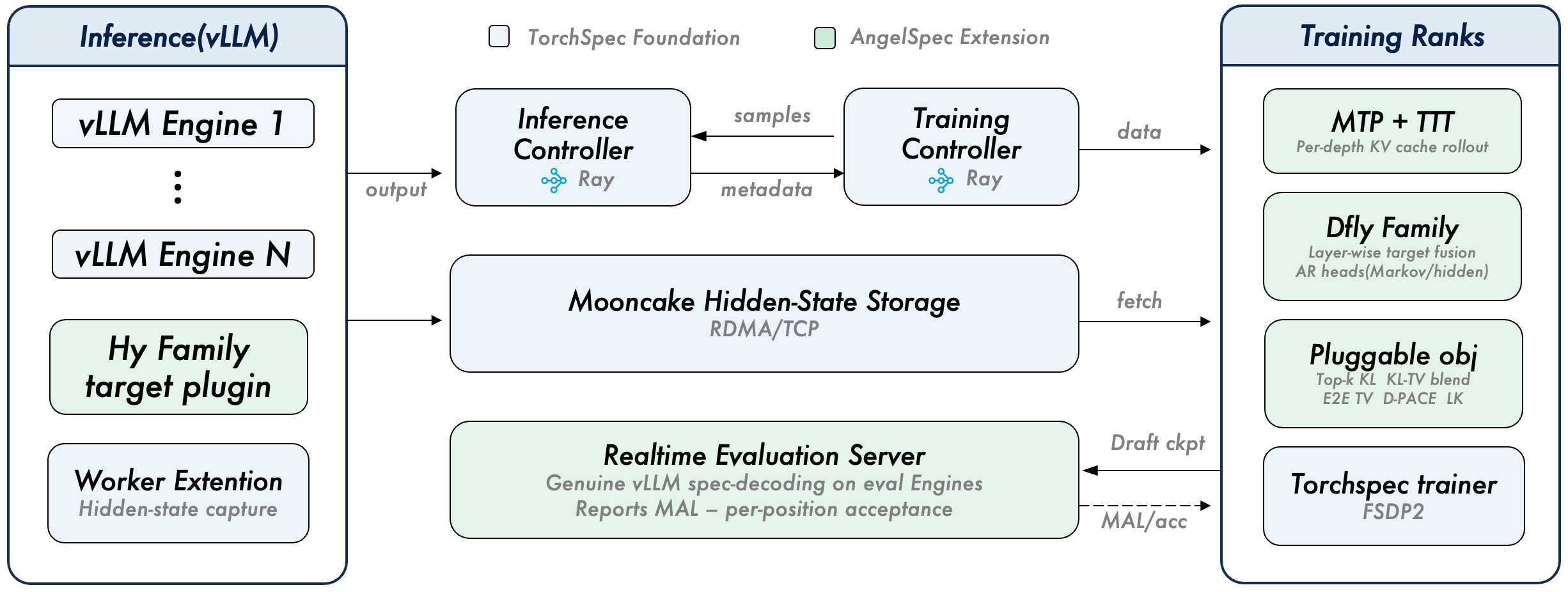
AngelSpec separates the two halves of feature-space draft training — generating the target model’s hidden states, and optimizing the draft model — so they run as independent groups of GPU workers connected by a shared tensor store.
Why disaggregate#
Feature-space draft models learn from the target model’s hidden states, so every training step needs those states for its batch. Producing them and optimizing the draft model have very different resource profiles: the target model is large and inference-shaped, while the draft model is small and training-shaped. Coupling them in one process forces the two to share GPUs and scale together.
AngelSpec instead runs them as separate worker groups that communicate only through a tensor store. Each side scales on its own: add inference engines for more hidden-state throughput, or add trainers for more optimization throughput.
Components#
All GPU workloads run as Ray actors, coordinated by a central controller.
Inference engines run the frozen target model and extract hidden states from selected layers during prefill. AngelSpec supports vLLM, SGLang, and HuggingFace backends behind a common engine interface.
Mooncake store (Mooncake) holds the hidden-state tensors in shared memory and moves them over RDMA, without materializing them to disk.
Training workers consume the streamed tensors and train the draft model under FSDP2. Each worker is a Ray actor owning one GPU and a slot in the data-parallel group.
Controller orchestrates the pipeline: it loads and batches data, dispatches prompts to inference, applies backpressure so inference does not outrun training, and drives evaluation.
Data flow#
The controller loads the dataset and feeds prompts to the inference engines.
An engine prefills the target model and captures hidden states from the configured layers.
Those tensors are written to the Mooncake store; only lightweight metadata (keys and shapes) travels through the controller’s queues.
Each training worker pulls the tensors for its shard of the batch directly from Mooncake and runs the draft model’s forward/backward.
The optimizer steps, metrics are aggregated, and checkpoints are written periodically.
Because the store decouples producer from consumer, inference and training proceed asynchronously, with backpressure keeping the in-flight buffer bounded.